People see me back at work. They see me walking through the halls, talking to students, answering questions, laughing at something ridiculous and doing the things I’ve always done. I’m getting up in the morning, getting dressed, putting myself together and showing up somewhere other than a hospital room or another doctor’s appointment. I’m eating again. I’ve gained weight. I’m moving around. From the outside, I can understand why someone would look at me and think the worst of this is finally behind me.
God, I wish it felt that way.
Emotionally, I am incredibly fragile right now. My depression is raw, and it is so damn heavy. There are mornings when I wake up already exhausted by the thought of having to hold myself together for another day. I can feel the weight of everything before my feet even touch the floor. Sometimes I lie there listening to the feeding pump humming beside me, staring at the ceiling, trying to convince myself to get up and be a functioning human being. Responsibilities are waiting. People are expecting me. There’s an entire day ahead of me, filled with things to do and conversations to have, but there are moments when even the thought of being perceived by another person feels exhausting.
Still, I get up. I put on my clothes, fix my hair, look in the mirror and try to make myself resemble the person I remember being before all of this. At work, I slip back into the familiar rhythm of answering phones, helping students and interacting with people. I laugh. I carry on conversations. I genuinely enjoy parts of my day. None of that means the depression has loosened its grip. Sometimes it just means I’ve gotten really good at functioning while something inside me is struggling.
What makes all of this even harder is that I haven’t been able to begin healing emotionally from what happened because physically, I’m still living it. There are no answers. No diagnosis explaining why my body suddenly stopped tolerating food, why I became so incredibly sick or whether it could happen again. A tube still comes out of my nose, taped across my cheek, with a port that sticks out from the side of my face. I feel it tug when I move a certain way. The adhesive sits against my skin, and the pump runs with that constant mechanical whir that follows me through my days and into my sleep. Even during a good moment, there’s usually something touching me, pulling at me or making noise to remind me that I’m still not free of any of this.
Around other people, I try to forget the tube is there and just be myself. Then someone’s eyes flick toward my cheek, even for a second, and suddenly I’m painfully aware of it again. I notice the second glance, the quick look away, the tiny changes in someone’s expression that they probably don’t even realize they’re making. My brain has always been sensitive to rejection and the possibility of being judged, so those seemingly insignificant moments can feel enormous. I can be in the middle of a perfectly normal conversation while another part of my brain is wondering what that person is thinking about my face. I hate that I care. I hate that something keeping me nourished can make me feel so uncomfortable in my own skin.
Then there’s the weight. Twenty-five pounds in one month. I can barely wrap my head around that number, much less what it feels like to live inside a body that has changed so dramatically in such a short amount of time. I needed to gain it. I know that. I watched myself become thin. Clothes started hanging off me. I lost strength, my muscles atrophied, barely ate, became dehydrated and eventually ended up in hospital rooms hooked to IVs before having two feeding tubes shoved through my nose because my body could no longer reliably give itself what it needed. I understand exactly why gaining that weight matters, and I am incredibly grateful that my body is finally accepting nutrition again.
But body dysmorphia doesn’t suddenly become reasonable because you understand the medical necessity of something. I can stand in front of the mirror knowing I needed every pound and still feel my stomach tighten when I look at myself. Clothes fit differently. My body feels unfamiliar when I move. I notice places that have filled back out, and my brain immediately starts picking them apart. It’s like listening to an argument I can’t escape, one part reminding me how sick I was while another struggles with the rapid changes. The weight has been its own mindfuck, and I wish understanding why I needed to gain it was enough to quiet everything happening inside my head.
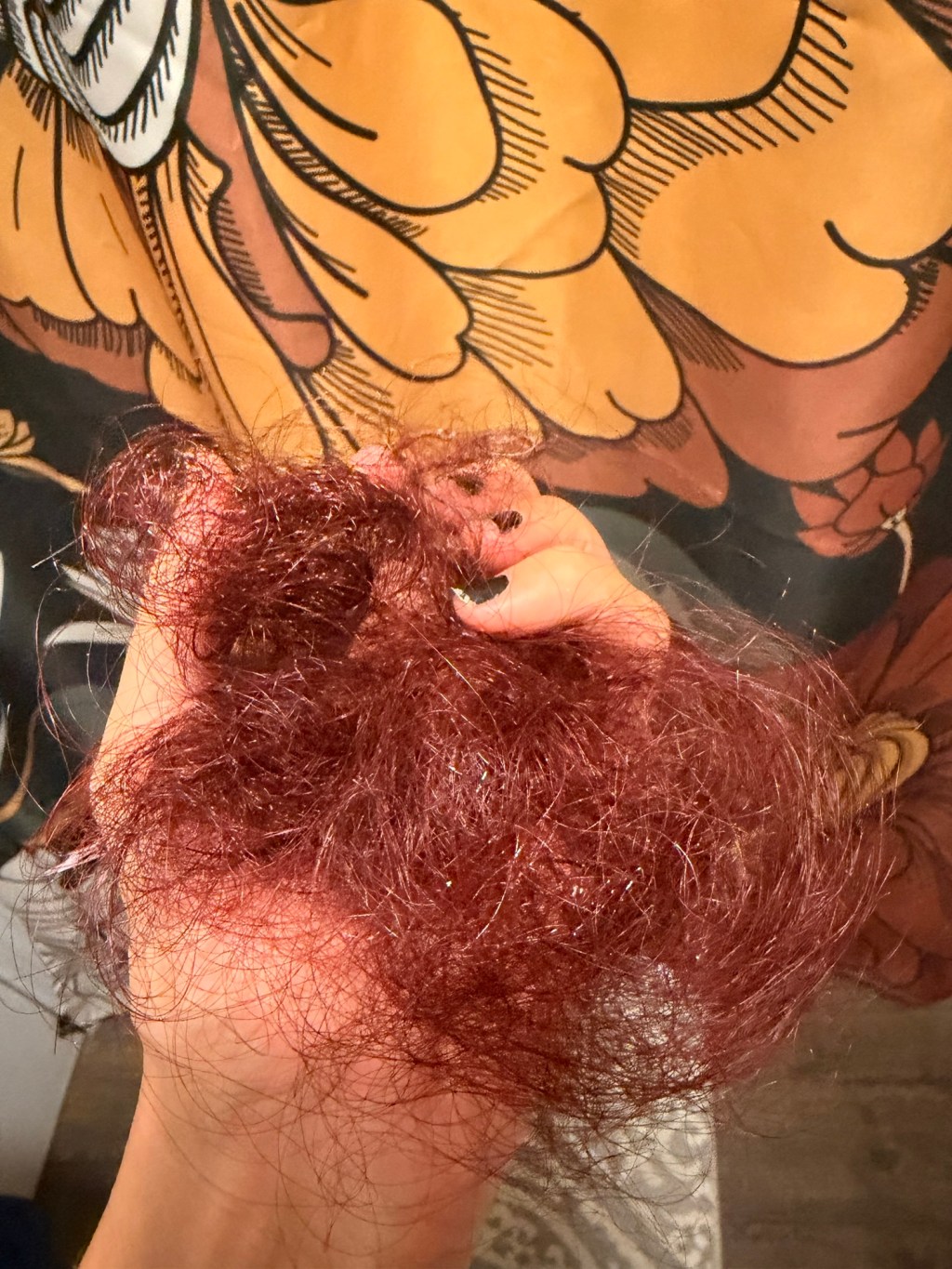
And now I’m losing my hair. These pictures are three days of hair loss. Three. Days.
There’s something incredibly unsettling about running your fingers through your own hair and feeling strands slide loose between them. At first, you tell yourself it’s normal shedding. Then you look down at your hand and realize there’s far too much there. You gather it together, and somehow there’s even more. It clings to your fingers, collects in the shower and catches in your brush. The more you try to gently separate it, the more you seem to find. Eventually you’re standing there holding this tangled handful of something that was attached to your head just days ago, trying to understand how your body can still be losing pieces of itself after everything you’ve already been through.
Looking at that handful of hair makes me feel sick. I know severe illness and malnutrition can cause significant shedding months later. I’ve read about it. I understand that the body prioritizes survival and that hair can suffer the consequences long after the immediate crisis has passed. But knowing the science doesn’t make it any less devastating to stand there holding it. My hair has always been part of how I recognize and express myself, and now even that feels uncertain. I’m already struggling with the changes in my body and the tube attached to my face. Watching my hair come out by the handful while I’m supposed to be celebrating how much better I’m doing feels like another cruel reminder of everything this experience has taken from me.
I am so tired of finding new ways this has changed me.
I’ve been trying to work through some of it in brainspotting therapy, too, but even that has become frustrating. My brain has built what feels like a thick brick wall around everything that happened. I can sense the fear on the other side of it. There’s an enormous amount of pain and trauma sitting there, waiting to be processed, but when I try to reach it, I can’t. It’s almost like standing outside a locked room in your own house. You know what’s behind the door. You can feel how much space it takes up. You know you need to go in there eventually, but no matter how hard you turn the handle, it won’t open.
Part of me wonders whether my brain is keeping that door closed because my body is still living through the very thing I’m trying to process. How am I supposed to convince myself that I’m safe when I still don’t know why I got sick? How do I work through the fear of needing a feeding tube when I wake up every morning with one taped to my face? How can I put something behind me when every day contains another reminder that it hasn’t actually ended? And the other part is, I know I’m not healthy yet. I feel it. I don’t care what lab values show or how much weight I’ve gained because I’m getting double calories daily. I still feel like my body could flip back to being critically ill at literally any second.
There have been two times in my life when I was medically sick enough that I genuinely questioned whether I was going to die. This was one of them.
I need that to sit there for a moment because those words carry a weight I don’t think I could ever fully explain to someone who hasn’t felt that kind of fear. I don’t say them for dramatic effect, and I certainly don’t write them lightly. There is something deeply frightening about watching your own body deteriorate while the people trying to help you cannot tell you why it’s happening. About feeling weaker and weaker, being unable to do something as basic as eat or drink enough to sustain yourself, and realizing that sheer determination isn’t going to fix it. I’m someone who likes answers, plans and solutions. Give me a problem and I will throw everything I have at figuring it out. But I couldn’t think my way out of this. I couldn’t work harder, push through or simply decide to get better.
Instead, I had to lie there and trust that someone would figure out how to help me while I felt my body slipping further away from the one I’d always known.
That fear doesn’t disappear just because I’m back at work now. The uncertainty and helplessness of those months are still very real to me. Something happened inside my body that nobody has been able to explain, and that scares the absolute hell out of me. Every strange sensation, wave of nausea or day when my appetite disappears or my energy suddenly crashes can bring that fear rushing back. I want so badly to trust my body again, but I don’t know how to do that when I still don’t understand why it stopped doing something as fundamental as nourishing itself.
Underneath all of this is a depression that has become heavier than I think most people realize. I can be surrounded by hundreds of people during the day and still feel incredibly alone in what I’m carrying. Someone might notice the tube, comment on my weight gain or tell me I look better, and I know those words usually come from a place of kindness. What they cannot see is the way my thoughts spiral when I’m alone, how much energy it takes to keep them from swallowing the good moments, or the fear that follows another unexplained symptom. They don’t see the frustration of sitting in therapy and feeling unable to reach the very things I desperately need help processing.
They certainly don’t see what it feels like to hold three days’ worth of your own hair in your hand and wonder how many more parts of yourself you’re going to have to watch change before this is finally over.
I know there are people going through things far worse than what I’ve experienced. I’m fortunate to be alive, to be receiving nutrition and to have made enough progress to return to work. I feel that gratitude deeply. I thank God for it. But sometimes I catch myself using that gratitude to silence everything else I’m feeling, as though acknowledging how badly this has affected me somehow makes me less appreciative of surviving it. I’ve spent so much time reminding myself of how lucky I am that I’ve barely given myself permission to acknowledge how frightening and devastating this has been.
This experience has affected my relationship with food, my body, my independence, my mental health and my ability to feel safe inside my own skin. It’s changed the way I experience ordinary things I never used to think twice about. I’m still in the middle of it, trying to function, trying to heal and trying to make sense of something that hasn’t given me the answers I need.
So when you see me at work, laughing, talking or going about my day, please understand that those moments are real. I genuinely love being back with the students. I love having a reason to get dressed in the morning and feeling useful again. I want those ordinary pieces of my life back more than I can explain. There’s just an entire other part of my experience happening underneath the surface, and right now that part of me is incredibly tender.
I don’t need another reminder of how strong I am. I’ve survived a lot. I’ve pushed through things that once seemed impossible. Right now, though, I’m exhausted from having to be that person over and over again. I want to feel safe and comfortable in my own body. I want to wash my hair without dreading what I’ll find in my hands, look in the mirror without immediately noticing everything that’s changed, and wake up one morning with my first thought being about something beautiful or ordinary instead of whatever my body might do to me that day.
More than anything, I want some peace inside my own head.
People see me getting my life back, and in some ways I am. I’m grateful for every bit of progress I’ve made. But there are parts of me that are still sitting in those hospital rooms, still frightened, still waiting for answers and trying to understand what happened.
I wish people could understand how lonely it can feel to be visibly recovering while emotionally you’re still trying to find your way out of what you survived.


Express Yourself!