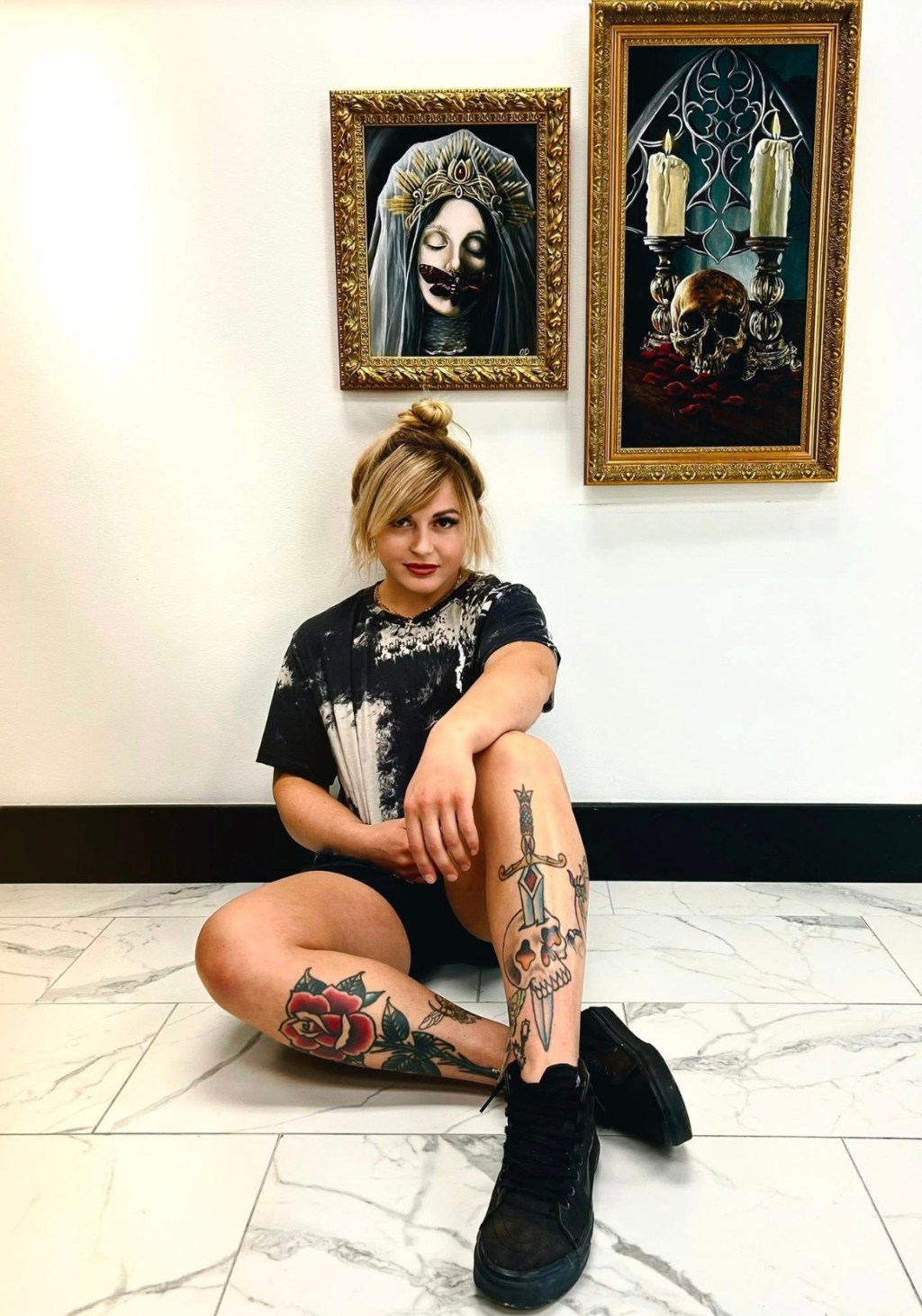
The art, grit, and quiet heart behind the ink.
There are people you know by what they do, and then there are people you get curious about because somewhere along the way, you realize there is so much more underneath it. I originally knew Jules because she was my tattoo artist. I trusted her with my skin, with ideas that meant something to me, and eventually with pieces of my own story that I wanted to carry permanently on my body. She has created many of the stories that now live on my skin, but after enough hours spent on the other side of her tattoo machine, I started noticing all these other pieces of the person holding it.
The woman who can create something dark and haunting loves being outside with her hands in the dirt. She loves loud music and concerts, but some of her deepest peace comes on the back of a horse. She lifts weights, trains Brazilian Jiu-Jitsu, tackles DIY projects, gardens, loves nature, and can play the same song over and over because something about it has gotten inside her head and started turning into art. I knew Jules the tattoo artist, but I wanted to know more about Julia, the woman underneath all of it. And to understand Jules, you really do have to start there.
Long before the steady buzz of a tattoo machine became the background noise of her days, Julia’s world sounded a lot different. She grew up on a cattle farm in Manchester, Michigan, where being outside wasn’t something saved for a beautiful afternoon. It was simply where life happened. She was a shy little tomboy who would rather be outside getting dirty than almost anywhere else, riding bikes and four-wheelers, swimming, playing around the farm and growing up surrounded by animals. Horses had her heart almost from the beginning.
Both of her parents left different fingerprints on the woman she would become. Her mom traveled often for work, and looking back, Jules sees a strong, career-driven woman who gave her an example of what it looked like to work hard and build something for yourself. She was someone Julia could look up to, and there is something fitting about that now, knowing that her daughter would eventually build a career in a field that wasn’t necessarily the obvious or expected path for her either.
Because her mom traveled for work, Julia and her brother spent much of their day-to-day childhood alongside their dad. From the time she could walk, she was outside with him on the farm. He taught her hard work, perseverance and responsibility, although I don’t get the impression there were many long speeches involved. He is a quiet, stoic man who rarely raised his voice, and Julia remembers that she and her brother usually just needed the look. They knew exactly what it meant.
He was also the person she could go to when something hurt, scared her or weighed on her mind. Somehow, he knew what to say or how to make whatever she was carrying feel a little lighter. All these years later, Jules still calls her dad her rock, and looking at her now, it isn’t hard to see pieces of him in her.
Jules describes herself as an introvert and fairly stoic too. She doesn’t always show when she’s sad or when something is weighing on her, and actually allowing herself to feel those emotions instead of tucking them away is something she is still working on. Underneath that quieter exterior, though, is someone who has always cared deeply. She loves making other people smile, partly because their happiness has a way of finding its way back to her.
Art was there almost as early as the animals were. Julia has been drawing for about as long as she can remember. Her grandma gave her her first drawing book, and those early pages filled with horses. Even in kindergarten, other kids noticed how good they were, and her grandma certainly noticed. She encouraged Julia’s art and still has more of her paintings hanging in her home than anyone else. Before Julia knew art could become a career, someone she loved was already treating the things she created like they were worth keeping.
One of the other people who helped shape Julia as an artist came from somewhere I wasn’t expecting when Jules told me her story. There was an elderly woman who lived nearby when she was little, eccentric enough that plenty of people around the neighborhood simply referred to her as the “crazy lady.” Julia and her brother never saw her that way. To them, she was the woman whose house they could wander into for Little Debbie brownies, someone who loved them like grandchildren and happened to be an artist too.
Julia was only four or five when she began sitting with her, painting watercolor landscapes while this wonderfully eccentric woman critiqued her work and offered little pointers. One tiny detail has stayed with Jules all these years. She remembers watching her neighbor bring a watercolor brush to her mouth, lick the bristles into a fine point and hand it back. Jules still catches herself doing the exact same thing when she paints with watercolor today.
Her neighbor passed away only a few years later, but somehow life brought Julia back to the place where some of those earliest memories were made. She lives in that woman’s house now, inside the same walls where a tiny Julia once ate Little Debbie brownies, watched watercolor move across paper and learned from one of the first artists who nurtured something in her. Of all the pieces of Jules’s story, that one feels a little like life quietly closing a circle.
By high school, art was easily Julia’s favorite class, but loving something and believing you can build a life from it are two very different things. She didn’t have some carefully mapped-out future. As a kid, she thought she might do something with animals, and drawing and painting were simply the things she loved. Her parents weren’t particularly excited about art school, and graphic design didn’t give her the same feeling as creating something with her own hands. Julia wanted pencils and paint, something tangible in front of her, something she could actually make.
Tattooing had started to catch her attention. She thought tattoos were cool and wondered if there might be a way into that world, although she admits the whole thing intimidated her. There wasn’t some dramatic moment when she announced that she was going to become a tattoo artist because she wasn’t even sure how someone became one. Then a family friend who had previously tattooed and was building tattoo machines as a hobby opened that door a little. He showed Julia some of the basics, gave her her first tattoos and eventually helped put a machine in her hands.
From there, Julia started tattooing friends and family, and her cousin Anthony was brave enough to become her first. Thankfully, Anthony already had plenty of tattoos, which made putting that first permanent mark on another human being slightly less terrifying. Julia tattooed a little skull on the back of his calf. It wasn’t perfect, and they made it better later, but I love that part of her story. Every artist whose work makes us stop and stare once had a beginning. Before Jules was the person people trusted with portraits, realism and large pieces, there was a nervous young Julia, a tattoo machine in her hand and a little skull on her cousin’s calf that still needed some work.
Those early tattoos on Anthony ended up doing far more than giving Julia somewhere to practice. Anthony had known a tattoo artist named Ira for years, and Ira eventually saw some of Julia’s work on him. Julia had spent close to a year wondering whether she was actually good enough to get an apprenticeship. Ira saw something in her that she wasn’t quite able to see in herself yet, and he offered her one when she was only eighteen or nineteen.
That apprenticeship brought Julia into Ethos, and in a lot of ways, that’s where Jules the tattoo artist really began. For roughly five years, she and Ira worked in the same room, side by side through the countless hours it takes to turn natural ability into an actual craft. There were tattoos, mistakes, critiques, conversations and all those ordinary days that don’t seem particularly important while you’re living them but eventually become part of who you are.
Jules calls Ira her “tattoo father,” and she means it. They’ve seen the good parts of each other and the ugly ones, watched each other grow, and somewhere among all those hours spent creating together, mentor became family. It was during her apprenticeship, after completing one of her first tattoos there, that something finally clicked for Julia and she had that holy shit, I’m actually an artist. Which is kind of funny when you think about it because people had been telling her that since she was drawing horses in kindergarten. It just took Julia a little longer to believe them.
Learning to believe herself may be as much a part of Jules’s story as learning to tattoo. She’s spent years dealing with negative self-talk, and there have been seasons when people she thought would remain in her life simply didn’t. Those losses changed the way she sees relationships. She has come to understand that some people aren’t meant to stay forever. Some are only supposed to be with us for a season, teach us something and then continue on their way.
What struck me most was what she said after that. She hopes that when people leave her life, somehow they leave a little better than when she found them. There isn’t bitterness in that. People can hurt you, leave you, teach you and change you, and you can still hope you gave them something good while they were yours to know. I think that says a lot about her.
Tattooing required her to learn to trust herself too. In the beginning, it was looked down upon as a career choice for her, and it wasn’t necessarily the future other people imagined for Julia. She stuck with it anyway. What started as something intimidating became an art form she loves, a career that has provided for her, a community and a way of connecting with people she never could have predicted when she first picked up a machine.
Somewhere in all of that, Jules also learned how important it was to stop shaping herself around what other people expected. Authenticity matters deeply to her now. She tries to stay aware of both her strengths and weaknesses while still being true to herself, even when that version doesn’t fit neatly inside someone else’s expectations. Jules doesn’t fit particularly well into a box anyway.
Her quietness doesn’t always look particularly quiet. Sometimes peace is open air and a horse beneath her, and sometimes, apparently, it is another human being trying to choke her on a Brazilian Jiu-Jitsu mat. She trains and competes because she loves the community and the feeling that comes from overcoming something genuinely difficult. She lifts too, and somewhere between heavy weights, tired muscles and the days when showing up sounds miserable, she learned something that followed her outside the gym: sometimes you have to do things you don’t feel like doing because discipline matters more than motivation.
Then there’s the music. Heavy metal, country, hip-hop, rap. Jules doesn’t particularly care about staying inside one genre any more than she wants to stay inside one style of tattooing. When a song catches the exact emotion she’s looking for, she’ll play it again and again, letting it fill the space around her until some part of it finds its way into whatever she’s creating. Right now, she’ll also admit to having a bit of a girl crush on Ella Langley. She gardens, tackles DIY projects, goes to concerts and wants to be outside. She likes staying busy, making things and getting as much as she can out of the experiences in front of her.
And then there is Caddy, or Jets Bouncy Cadillac if we’re being formal, which is far too good of a registered name for me not to include. Jules was about sixteen when Caddy came into her life as a two-year-old Quarter Horse, so in many ways they’ve grown up together. More than a decade later, Jules calls them soul sisters and laughs that they even have similar personalities, mostly laid-back with a playful side hiding underneath.
When everything else gets loud, riding gives Jules somewhere she doesn’t have to create, compete or figure anything out. There is simply the movement of Caddy beneath her, the open air around them and the familiarity of an animal who has been beside her through entire versions of herself. Jules says that peace “feeds the soul,” and knowing everything else that fills her days, it’s easy to understand why.
That softer side of Jules is interesting when you put it beside some of the art she creates. If you only glanced through her work, you could easily decide you knew exactly who she was. There are skulls, dark imagery, horror and pieces that can be intense, and then come the flowers, animals and nature. There’s the woman growing things in the dirt, riding through the quiet on Caddy and stopping to appreciate the natural world around her. Jules doesn’t see those as different versions of herself. They’re simply different pieces of the same person.
For her, pain and happiness belong to the same life. She believes we need to experience pain to truly understand happiness, and those experiences can feed creativity too. For someone who doesn’t always show emotion easily, art gives those feelings somewhere else to go. Sometimes there aren’t words for what you’re feeling, but there can still be an image, a painting or something created with your hands.
That understanding of art takes on another meaning when another person’s body becomes the canvas. There is an enormous amount of trust involved in handing someone your body, an idea that means something to you and often the story underneath it, then asking them to make it permanent. Jules understands the weight of that.
She wishes more people understood that tattoos aren’t meant to be rushed because there is far more happening behind the scenes than what a client sees during an appointment. There is drawing, planning, changing details, considering how an image will sit on someone’s body and how it will live there years from now. Behind the hand holding that machine are years of practice, and sometimes caring about the person in her chair means telling them no. If Jules believes something isn’t going to look good, the subject isn’t something she feels comfortable putting her name on, or she genuinely believes someone may regret it, she’s willing to turn it down.
Then the machine starts buzzing and something else tends to happen. People talk. Anyone who has spent hours in a tattoo chair probably understands it. You can only make small talk for so long while another person is sitting inches from your skin, and eventually real life sneaks in. People tell Jules about the person they lost, the relationship that ended, the thing they survived, something they’re celebrating or something they’re still trying to understand. She listens and offers support when she can, but she’s quick to point out that the exchange isn’t one-sided. Her clients have taught her plenty too.
That connection is a big part of what Jules believes her purpose might be right now. She can help someone express a part of themselves they couldn’t quite put into words, create something that helps them feel better about themselves, or give them something tangible to carry through an emotional time. On other days, the most important thing she gives them may simply be a place to talk while she listens. It turns out a career built around art also gave the quiet, nurturing girl from Manchester a pretty unexpected way to care for people.
As much as Jules loves tattooing, she has no interest in getting comfortable enough to stop growing. She doesn’t want to repeat one style forever simply because she knows she can do it. She likes being challenged and wants to become stronger with family portraits, continue developing a creative style of her own and take on more unusual pieces that force her beyond what she already knows.
What she isn’t particularly interested in is fame. She doesn’t have some carefully mapped-out plan to own a shop either. If that becomes part of her life someday, she’s open to it, but it isn’t the finish line. She wants to keep tattooing, keep improving and create work she’s proud to put into the world. If she could choose what her name eventually means in the tattoo world, she doesn’t need a long answer: respectable. It’s one word, but it feels very Jules. Do good work, care about what you put your name on, treat people well and keep showing up for the things that matter.
All these years later, Jules has found her way back to Ethos, and knowing where her story started makes that return mean something different. She isn’t walking into an unfamiliar shop trying to figure out where she belongs. She’s returning to the place where she learned this craft, back beside the man she still calls her tattoo father and into a culture whose values already feel like her own.
Jules trusts Ira enough to want the critique, not just the praise. Their tastes in art are similar, but more importantly, she knows how deeply he cares about what they put on another person’s body. After spending some of the most formative years of her career working beside him, there is something familiar about being back around the buzz of tattoo machines with someone who knew her art while it was still becoming her art. It’s a new chapter, but it isn’t starting over. It’s coming home.
If fifteen-year-old Julia could see the life Jules has built, Jules thinks she’d probably say it was crazy. And when you consider where she started, it’s easy to understand why. Art went from something she loved to something she built a life around. The young artist who spent so much time wondering whether she was good enough became the person other people now trust with permanent pieces of themselves.
Of everything she’s accomplished, though, the thing Jules is proudest of outside tattooing is much simpler. She stayed strong through some really difficult times. Those seasons changed her, but they didn’t take away the parts of herself that mattered. She’s still figuring some things out, still becoming and still trying to be a better person as she goes.
She doesn’t know exactly what the next five or ten years will look like. There may be companionship, possibly a family, more tattoos, more challenges and plenty she hasn’t imagined yet. She’s okay with that. Jules feels blessed by the life she already has and is willing to let the rest unfold as it comes. Right now, she believes part of her purpose is simply helping the people who cross her path, whether that happens through something she creates for them, something they tell her while sitting in her chair or simply being the person willing to listen.
For someone who creates permanent marks for a living, Jules doesn’t need some elaborate legacy. She hopes her name in the tattoo world means respectable, and when someone says years from now that they knew her, she hopes the next thing out of their mouth sounds considerably more like Jules:
“She’s cool asf.”
And really, that feels pretty damn fitting.
If you want to meet the artist behind all of this, Jules is now tattooing at Ethos Tattoo in Saline, Michigan, back where so much of her own story as a tattoo artist began


Express Yourself!